


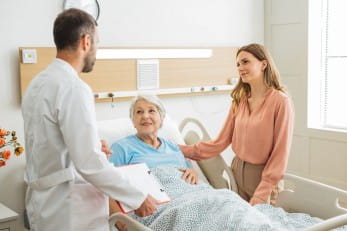


About Geisinger’s Hospital at Home program
Through Geisinger’s Hospital at Home program, you can get the same expert care and monitoring you’d expect at the hospital — but from the comfort and privacy of your own home. Your care team uses in-home visits, virtual check-ins and remote monitoring to stay connected, keep track of your progress and adjust your treatment when needed. You'll have the services and support you need for recovery while staying in a comfortable, familiar environment.
The result? High-quality, hospital-level care with more comfort, privacy and independence. You'll spend less time away from family, have fewer disruptions to daily life and enjoy greater peace of mind as you focus on healing.
Interested in the program? Talk to your healthcare provider. They’ll determine whether it's a safe and appropriate option based on your condition and recovery needs.
Who is eligible?
If you’re a possible candidate for Hospital at Home, we’ll check to be sure the program will not only be safe for you, but benefit your recovery.
Your doctor will examine your case to determine your eligibility. Ideal candidates are recovering from a condition that requires hospital treatment, but not round-the-clock observation. Also, you must:
- Live about 25 miles from the hospital
- Be a Geisinger Health Plan member or have traditional Medicare part A coverage
- Be 18+ years old
- Have a home environment that meets social determinants of health (SDOH) requirements
- Accept patient responsibilities, which may include daily tasks like charging your wearable device or weighing yourself
Mary’s experience with Hospital at Home
Mary shares how Hospital at Home helped her recover safely and comfortably at home.
FAQs
What are common conditions that are eligible for Hospital at Home?
Common examples of conditions or situations that meet the criteria include:
- Pneumonia
- Heart failure
- COPD
- Asthma
- UTI
- Cellulitis (skin infection)
This list is not all inclusive. Every patient’s eligibility is determined on a case-by-case basis.
Who is eligible for Hospital at Home?
Your doctor will examine your case to determine if you’re eligible. Ideal candidates are recovering from a condition that requires hospital treatment, but not round-the-clock observation. Also, you must:
- Live about 25 miles from the hospital
- Be a Geisinger Health Plan member or have traditional Medicare part A coverage
- Be 18+ years old
- Have a home environment that meets social determinants of health (SDOH) requirements
- Accept patient responsibilities, which may include daily tasks like charging your wearable device or weighing yourself
Can I request Hospital at Home care?
How does the program work?
Once you’re approved for the program, you’ll be given instructions and sent home. A team member will meet you at home and set up your equipment, including a tablet for speaking with your provider.
When you leave the hospital, don’t remove your hospital wristband. Our Hospital at Home team will come to your home promptly to set you up.
We provide:
- Daily in-person and virtual visits from your medical team
- A device you wear on your arm that constantly monitors your vital signs
- A tablet with a call bell that connects you directly with your medical team
- Treatments needed for your care
- Oxygen or any other medical equipment needed
What does it cost? Will my insurance cover it?
Can I choose whether or not to receive Hospital Care at Home?
Can I opt out if I don’t like the program?
Can I take off my hospital wristband?
What happens in an emergency?
Can I leave my house during my Hospital at Home treatment?
Do I need to have internet/Wi-Fi?
What is the discharge process? What happens when my care ends?
Who do I call if I need technical support?
Geisinger's Hospital at Home program
Recover safely and comfortably at home through our Hospital at Home program. You’ll have:
- Family, friends and pets close by: A familiar environment and a furry friend can put you at ease and might help you recover faster.
- Better outcomes and lower risks: Avoid unnecessary exposure to germs that could be found in a medical setting
- Care that continues beyond the hospital: Continue your healing in safety and privacy, while still seeing your healthcare provider.