
Bringing a legacy to life
The past matters, especially in places like central and northeastern Pennsylvania, where families put down deep roots that stretch across generations.
That’s why, if you look around many Geisinger facilities — especially the flagship hospital, Geisinger Medical Center in Danville — you’ll see reminders of our history and how it’s interwoven with that of the communities we serve.
As you pass through the hallways, take a moment to notice the photos and paintings on the walls and the displays of artifacts dating back to and even before the hospital’s founding in 1912 by Abigail Geisinger. The George F. Geisinger Memorial Hospital, as it was called then, opened in 1915.
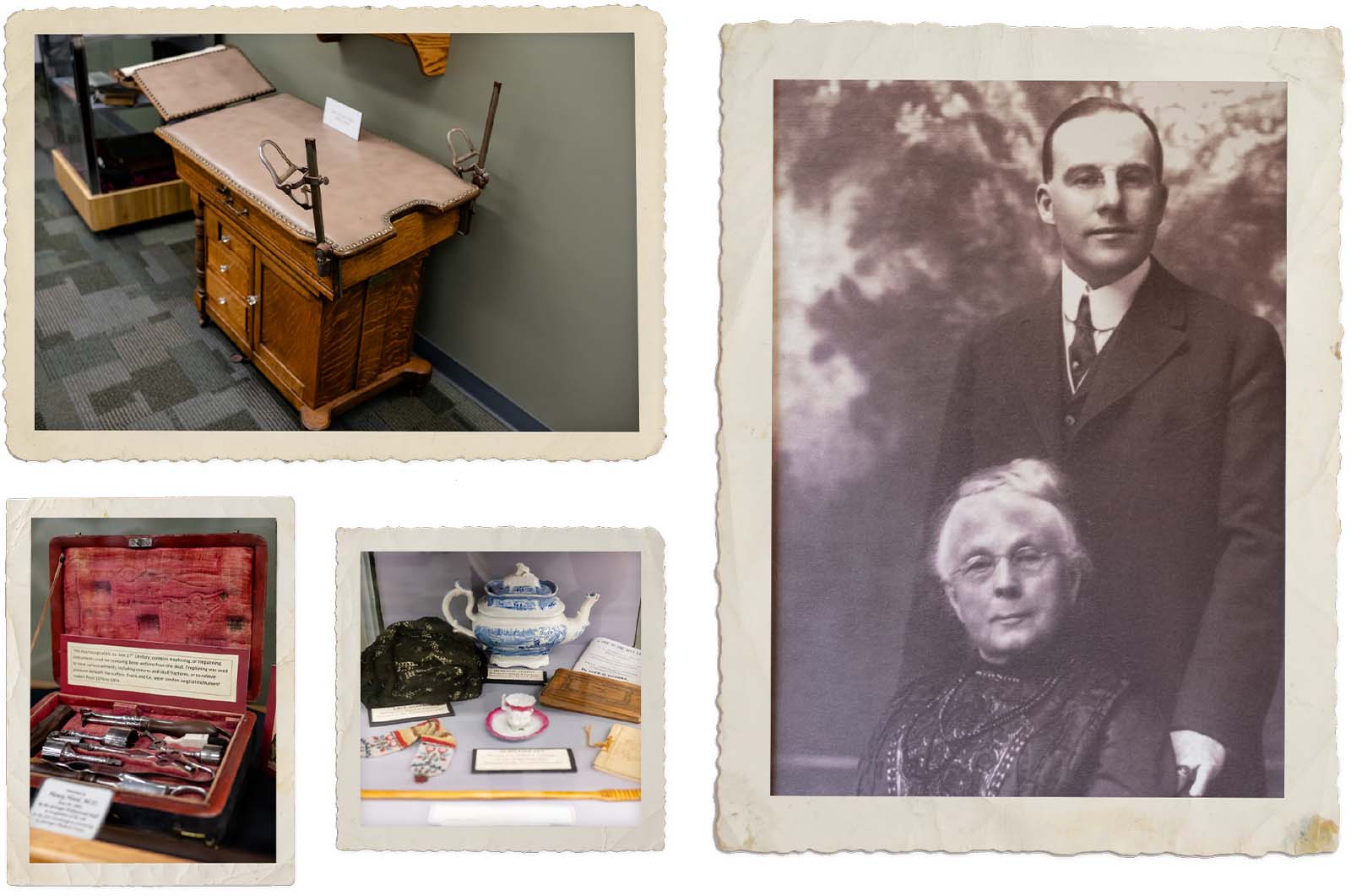
Oak exam table (circa 1900); portrait of Abigail Geisinger with Harold Foss, MD; teapot and other items that belonged to Abigail Geisinger; late 17th-century neurosurgical instrument kit
Scattered throughout the buildings — themselves running the gamut from venerable to modern — are antique nurses’ uniforms in pristine condition, portraits of notable people who shaped the system and medical and scientific instruments that have (thankfully) evolved as Geisinger and healthcare have grown and changed, too.
There’s even a small museum of microscopes through the ages in the Danville laboratory building.
“They’re like pieces of art,” says Kathy Heilman, who’s been maintaining Geisinger’s archival materials since 1983.
That’s right — Geisinger has archives, and they contain more than 14,000 records that document the history of its hospitals and clinics. Ms. Heilman is headquartered in the Health Sciences Library on the lower level of the Henry Hood Center for Health Research on the Danville campus. The College of Health Sciences houses a separate archive. Both archives are available on the libraries’ website.
The library features high-tech tools, like computer stations for Geisinger’s many learners and researchers, interspersed with objects like an antique examination table, surgical instruments from the Civil War era (“a little brutal,” Ms. Heilman notes) and even souvenirs from Geisingen, Germany, ancestral home of the Geisinger family.
As caretaker for all these treasures, Ms. Heilman has developed a fondness for system founder Abigail Geisinger, who appears stern in most surviving images, like her imposing oil portrait that watches over the medical center. But historical records show other sides of Mrs. Geisinger, including how she lent her personal vehicles — a carriage and later with a Hupmobile, an early model car — to transport ill people to Sunbury where the closest hospital was located.
“She was concerned about people,” Ms. Heilman says. “At Christmas, she would hand out baskets of fruit. And after the hospital opened, she would visit patients, bringing them flowers from her garden.”
Mrs. Geisinger was also an avid world traveler and, contrary to her serious expression in most images, was known to smile. At the laying of the hospital’s cornerstone, “she has her head back and she’s laughing,” Ms. Heilman says.
The collected artifacts also capture the growth and change of the system Abigail Geisinger envisioned. Photos from the founding show a parade of local people celebrating the Danville hospital’s opening, back when it was a relatively small building. If you search throughout the library and the campus, you’ll find images that trace the evolution of the grounds up to the present day.
Those who roam deep into the corridors near the Emergency Department in Danville will discover a large, multi-panel timeline with quotes from Geisinger staff and leaders, including Harold Foss, MD, who played perhaps the second-largest role in the system’s development after Mrs. Geisinger.
Dr. Foss, Geisinger’s first surgeon-in-chief, was also well-traveled and came to his new career from a job in Alaska. He was a Mayo Clinic-trained proponent of innovation and research, a pioneer in the use of motion pictures to demonstrate surgical techniques, the first to produce a 35mm color motion picture that was exhibited at a national meeting (American Medical Association, 1935), and a designer of medical devices still in use today.
His former residence next to Geisinger Medical Center, called the Foss Home, now houses the system’s administrative offices. Like the hospital, it’s also filled with furniture and photographs from the Geisinger and Foss families.
As part of her job curating all these treasures, Ms. Heilman is scanning images like those of Dr. Foss working in Alaska and Abigail Geisinger on a boating trip, so they’re readily available online. The photograph collection documents the growth of Geisinger from the time of Mrs. Geisinger to the present day.
“It’s always been a dream of mine to put this information out there so people can use it,” she says. And she believes innovative Abigail Geisinger would be happy to see the nationally recognized healthcare system she created.
“I think she’d be pleased with what we’ve done throughout the Geisinger system,” Ms. Heilman says.
Geisinger’s historical highlights:
- The Geisinger archives contains more than 14,000 records that document the history of its hospitals and clinics.
- Geisingen, Germany, is the ancestral home of the Geisinger family.
- Abigail Geisinger was an avid world traveler.
- Dr. Foss was the first to produce a 35mm color motion picture that was exhibited at a national meeting.
This story originally appeared in the winter issue of PA Health, our quarterly full-color magazine filled with wellness tips, inspiring stories and more.
Sign up to have PA Health sent to your mailbox or inbox 4 times a year, for free.