
Conducting life again after deep brain stimulation
For Marsha Rodgers, a 48-year-old Barnesville resident, music has always been more than a profession — it’s a passion, a calling and a way of life.
As a music teacher and band director for the Tamaqua Area School District, a singer and a flautist, her days were filled with rhythm and harmony. But for over 14 years, an invisible force began to steal the beat from her life: a neurological condition known as essential tremor.
Essential tremor causes rhythmic, uncontrollable shaking that can affect almost any part of the body, but most commonly the hands. It can make simple tasks, like drinking from a glass or tying shoelaces, feel impossible.
In Mrs. Rodgers’ case, tremors began in her hands and gradually took over almost all parts of her body. Even swallowing became an issue.
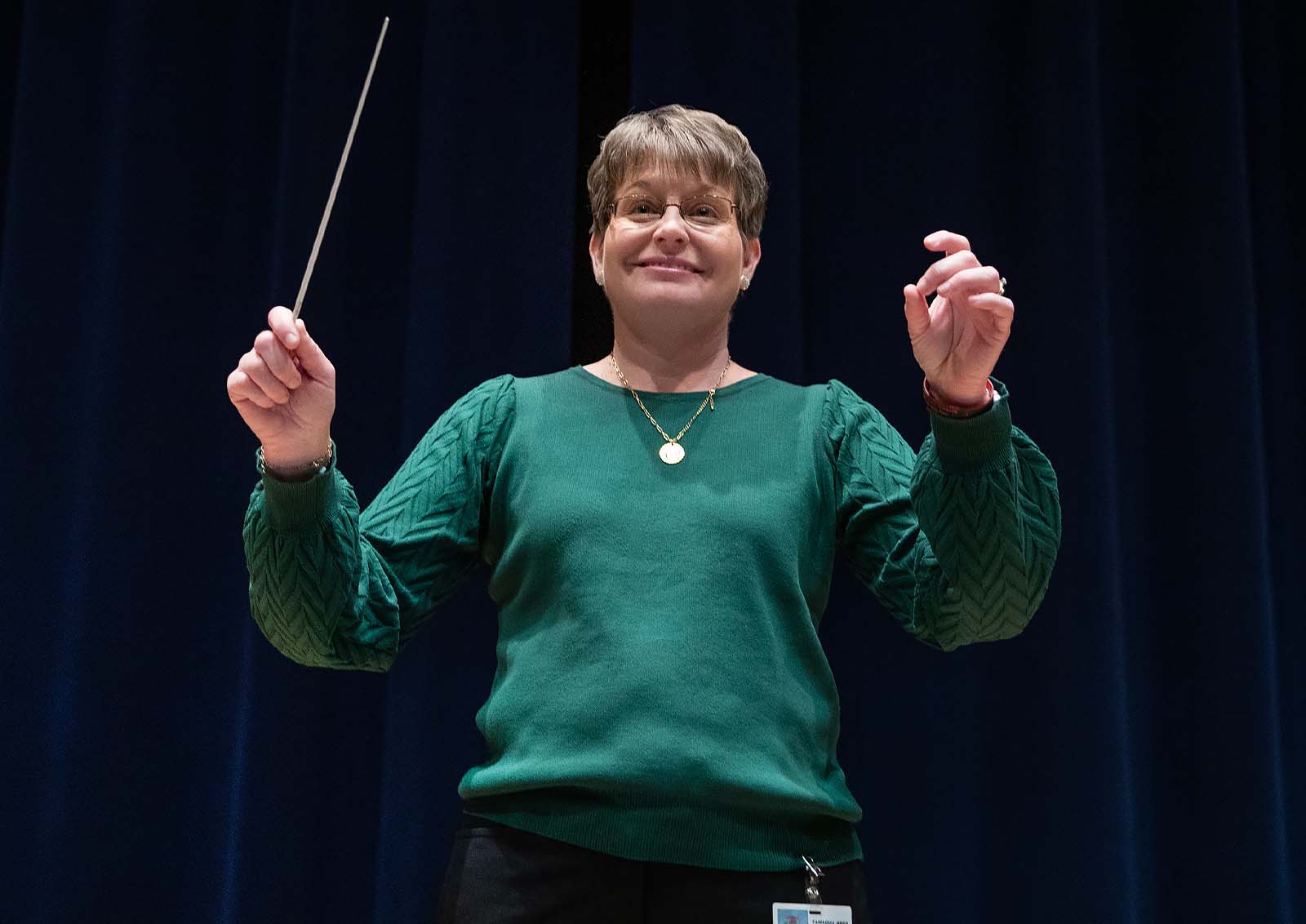
“I couldn’t hold a glass to drink out of it or even eat with weighted silverware,” Mrs. Rodgers recalls. “I couldn’t keep the food on my fork due to the tremors. Standing still was difficult because of the tremors in my legs. Everyday things were nearly impossible.”
Diagnosed in 2023 after years of misdiagnoses, Mrs. Rodgers’ condition worsened to the point where she could no longer conduct with a baton or play instruments alongside her students. Even singing became a challenge due to vocal tremors. “I was looking at going on disability if I didn’t have surgery,” she says.
A life-changing discovery
Mrs. Rodgers first learned about deep brain stimulation (DBS) when she saw a neurologist for migraines. Geisinger movement disorder specialist Cosmin Sandulescu, MD, helped her understand DBS and decide if it was right for her. And after attending one of the monthly PA Health Talks on DBS given by Geisinger neurosurgeon David Ferrone, MD, she began to see a glimmer of hope.
DBS surgery can dramatically reduce debilitating tremors. “DBS surgery for essential tremor is indicated when a patient has severe debilitating tremors that can’t be controlled with medications,” says Dr. Ferrone. “We’re not talking about just improving people’s quality of life — it’s also improving their sense of self.”
Renee Zapach, LPN, neurology nurse navigator, helps patients like Mrs. Rodgers coordinate appointments and follows up on their treatment and care. And crucially, she’s there if patients just need someone to talk to.
“Renee Zapach was fantastic — she’s the reason I had the surgery,” Mrs. Rodgers says. “She got me where I needed to go. I wasn’t heard at other facilities before this.”
Ms. Zapach remembers Mrs. Rodgers’ first visit vividly. “Her symptoms were severe — head, arms, legs, voice,” she says. “We treat patients like family. When someone’s going through something so life-altering, they need help to maneuver through the healthcare system. And we want them to feel comfortable with the treatment plan.”
Understanding DBS
Patients who elect to undergo DBS have electrodes implanted in specific areas of their brain. A device for generating electrical signals is also implanted under the skin of the chest and connected to the electrodes in the brain by a thin wire. The electrodes send electrical impulses that help regulate abnormal brain activity.
The DBS procedure involves 3 stages:
- Bone marker implant and imaging – MRI and CT scans done under anesthesia for planning the surgery
- Lead implantation – DBS leads placed precisely in the targeted area of the brain to improve symptoms
- Battery implantation – DBS leads connected to a neurostimulator implanted in the chest
Three weeks later, the device is turned on and fine-tuned to the patient’s needs.
Surgery and recovery
Mrs. Rodgers underwent the first part of her DBS surgery with Dr. Ferrone in November 2024, with the final stage completed in December.
Her recovery had some complications. Ten days after the leads were implanted, she had a rare seizure due to brain swelling around the lead in her frontal lobe. “There are risks,” Mrs. Rodgers says. “But I would do it all over in a heartbeat, because it gave me my life back.”
She now attends follow-up visits to adjust the device’s programming and can even make minor adjustments herself. “Everyone is different — it’s based on your comfort level,” she says. Even side effects like speech issues and a metallic taste were resolved with small programming tweaks.
Back to the baton
Today, Mrs. Rodgers is back performing music, teaching and conducting with very few tremors — living a life she once thought was out of reach. “I hated eating out because of my hand tremors, but not anymore,” she says. “Now I can perform again. I can hold my flute and play. I can sing with minimal vocal tremors.”
She’s also become a tireless advocate, sharing her story on TikTok, Instagram and YouTube to raise awareness about DBS and essential tremors. Her podcast interview with the International Essential Tremor Foundation was featured in their monthly “Tremor Gram.”
“She’s doing awesome,” Ms. Zapach says, adding that Mrs. Rodgers even leads a support group for people who have or are considering DBS, as well as their caregivers.
To anyone with essential tremor and other movement conditions, Ms. Zapach recommends getting a referral to a movement disorder clinic. “There are treatments — and hope — for these types of disorders,” she says.
A message of hope and healing
Through perseverance and the power of medical innovation, Mrs. Rodgers got more than symptom relief — she got the chance to reclaim what she loved.
“If you’re struggling, don’t give up,” Mrs. Rodgers says. “There’s help out there. DBS gave me my life back.”
Watch tremors improve after deep brain stimulation.

This story originally appeared in the winter issue of PA Health, our quarterly full-color magazine filled with wellness tips, inspiring stories and more.
Sign up to have PA Health sent to your mailbox or inbox 4 times a year, for free.