
Abigail Geisinger Scholars: Back — for the future
As Abigail Geisinger scholars return, they’re putting their skills to work as practicing physicians
When Scranton community leaders saw a looming shortage of primary care doctors to serve the region, they did something bold and visionary. They created a medical school to train homegrown physicians.
As a locally founded health system with a focus on keeping families healthy, Geisinger was a perfect fit for the new school’s mission, and the 2 joined forces in 2017.
The very next year, Geisinger went a step further, launching the Abigail Geisinger Scholars program, which offers Geisinger School of Medicine students a debt-free education and living support if they commit to practicing primary care in the health system after residency. Scholars can specialize in family medicine, internal medicine, medicine/pediatrics or pediatrics.
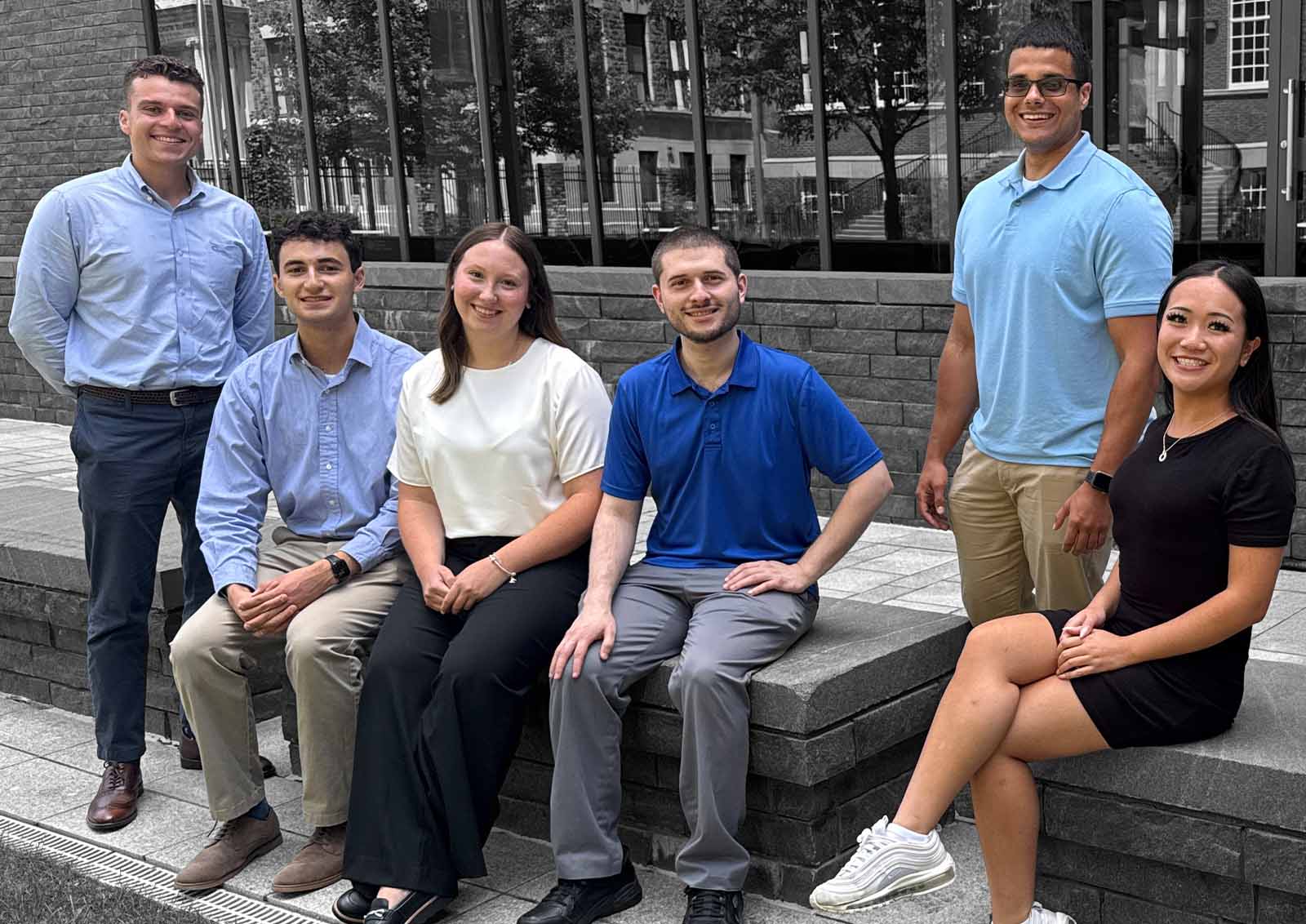
Steven Picozzo, MD (dark blue shirt), a Geisinger primary care physician, with Geisinger School of Medicine students.
Now, less than a decade since its development, the program has reached a major milestone, expanding from an inaugural class of just 10 students to admitting 45 per year.
“We are proud of the program, its growth and impact,” says Julie Byerley, MD, MPH, president of Geisinger College of Health Sciences. “Since the program’s launch through today, 275 students have enrolled, and 107 graduates in residency are set to return to Geisinger between fall 2025 and 2030.”
Doctors who share a vision
Graduating without debt is an undeniable program perk. But the initiative also tends to attract a certain kind of student, one who sees the value of family-centered care that results in long-term relationships with patients.
For Steven Picozzo, MD ’22, having the chance to study in and serve his home region was a huge program draw. He’s the first Abigail Geisinger Scholar to return to the system after residency to practice family medicine, at Geisinger Tunkhannock, and he remains grateful for the opportunity.
“I have family in northeastern Pennsylvania, and I wanted to stay within a reasonable distance of them,” he says. “Initially, I wasn’t sure if that was going to be possible. There was a great deal of peace of mind knowing I wasn’t going to have to separate from the people I love.”
Another returning scholar, John Pacheco, MD ’22, was raised in New England and appreciates that Geisinger took a chance on an “outsider” who knew from the start that family medicine was his calling.
“Family medicine is what I was meant to do,” says Dr. Pacheco, who’s practicing in Bloomsburg. “I will always be grateful for the training and financial opportunity this has provided.”
Of course, he’s not the only one benefiting. Dr. Pacheco notes that his patients are also “very grateful for the care we provide.”
Next gen care
The first returning scholars are just the start. A trickle will soon become a flood as even more new doctors come back to the region, armed with an outstanding Geisinger School of Medicine education and their personal convictions about the importance of whole-patient care and advocacy.
For scholar Mariia Gurevich, now a third-year medical student with an interest in family medicine, the program is a perfect fit for her background, lifestyle and goals.
An immigrant from Ukraine, Ms. Gurevich now lives in Mount Pocono with her husband and 2 children. She’s not only an Abigail Geisinger Scholar. She’s also taking advantage of a companion program that allows her to get into the clinic and graduate early.
It’s all “perfect for someone who wants to stay local and help the community,” she says. “You get early clinical exposure and build relationships with everyone, from physicians to pharmacists to front desk staff.”
An added financial benefit
Dr. Byerley also emphasizes a third, often overlooked program benefit: economic development.
“Our investment is close to $13.3 million annually, but the true impact goes far beyond that. Local students get to stay in the communities they love, and students from across the country are drawn to Geisinger’s unique approach to research and clinical care,” she says.
For students like Ms. Gurevich, the program’s benefits are more personal, but still community focused.
“If you’re confident in your specialty and want to serve your community, this program is a game-changer,” she says.

This story originally appeared in the fall issue of PA Health, our quarterly full-color magazine filled with wellness tips, inspiring stories and more.
Sign up to have PA Health sent to your mailbox or inbox 4 times a year, for free.